Free AI Visibility Tool
Powered by Semrush AI Visibility Toolkit
Check your brand’s visibility in AI search results across ChatGPT, Gemini, AI Mode, and AI Overviews. Find visibility gaps and opportunities to grow your AI search presence.
You will see:
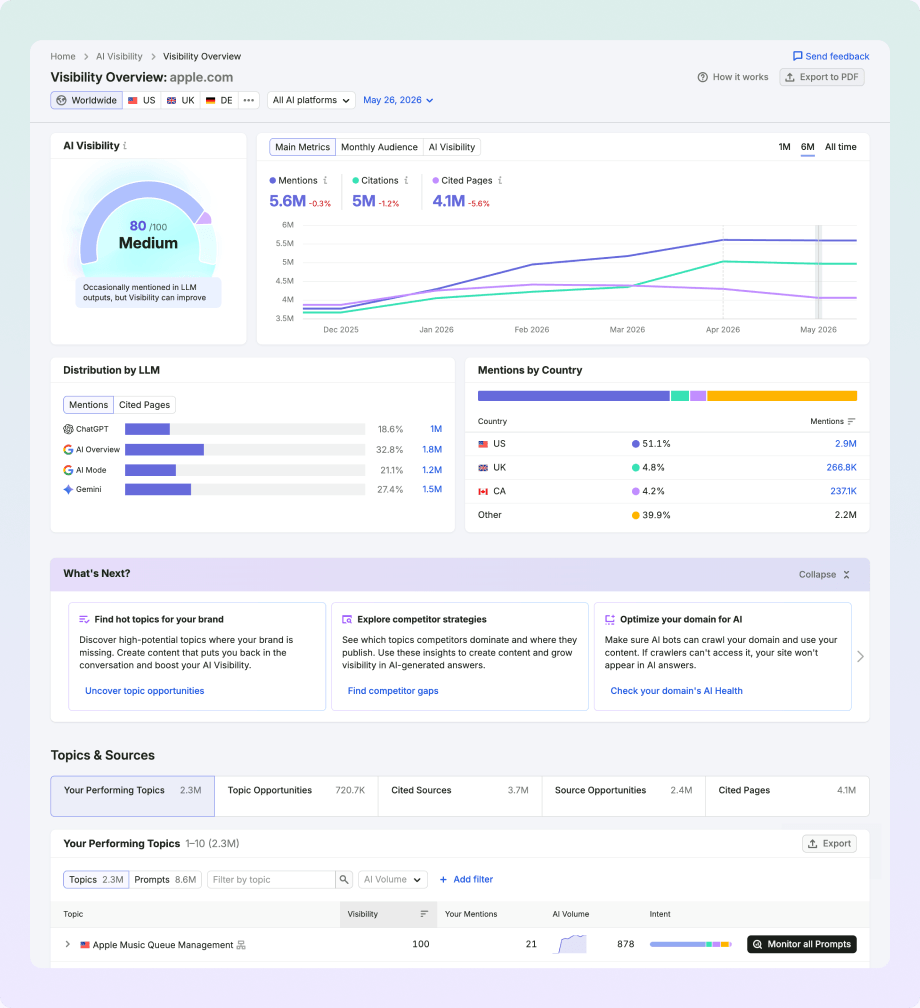
- Your AI Visibility Score across all AI platforms
- Total number of brand mentions in AI answers
- Mention breakdown across ChatGPT, Gemini, and Google results
- Pages from your website that drive the most AI citations
- Topics and prompts where your brand appears
- Estimated audience reached through AI search
Need more than a free AI visibility tool? Try the AI Visibility Toolkit
How to Use the AI Visibility Tool
1
Enter your domain or website URL in the field above2
Click "Check AI Visibility" to generate your visibility report3
Review your brand’s complete AI visibility analysis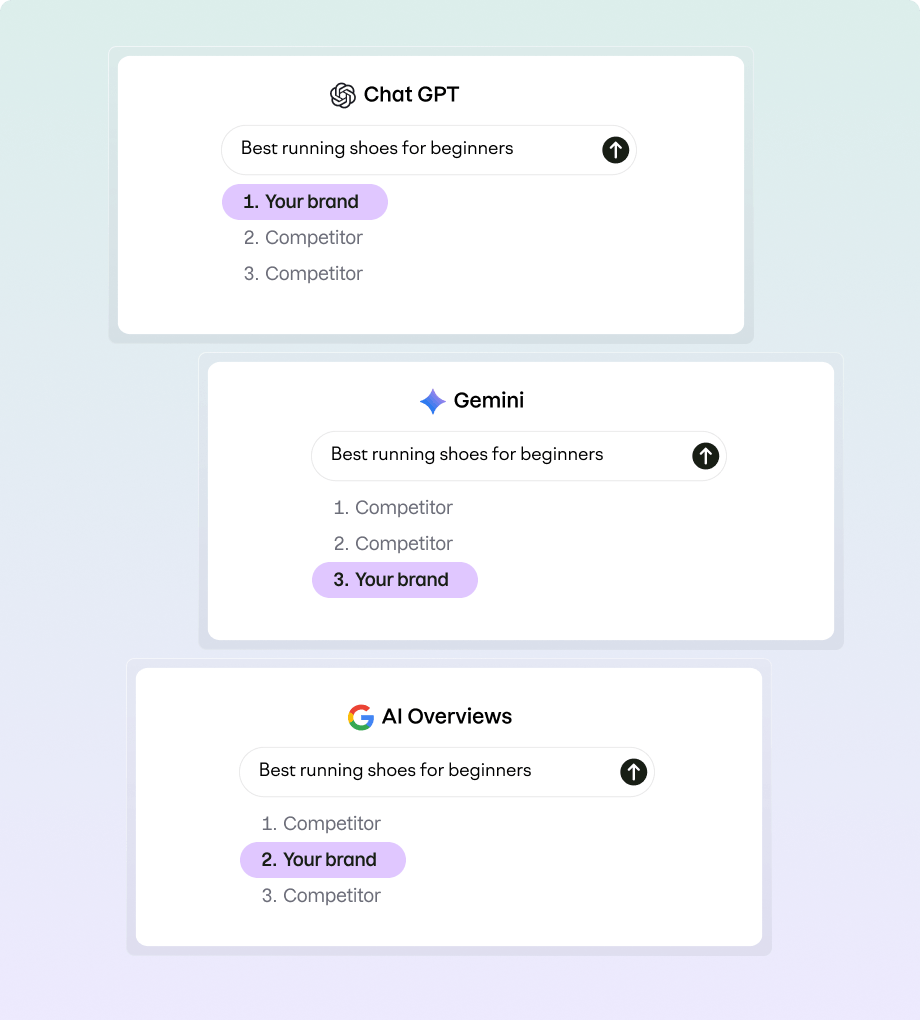
What Is AI Visibility?
AI visibility is how often and how clearly your brand appears in AI-generated answers across platforms like ChatGPT, Gemini, AI Mode, and AI Overviews. It shows whether AI search platforms mention your brand when people ask questions related to your products, services, category, or competitors.
Strong AI visibility means your brand is more likely to appear in relevant answers, be described accurately, and be included when users compare options.
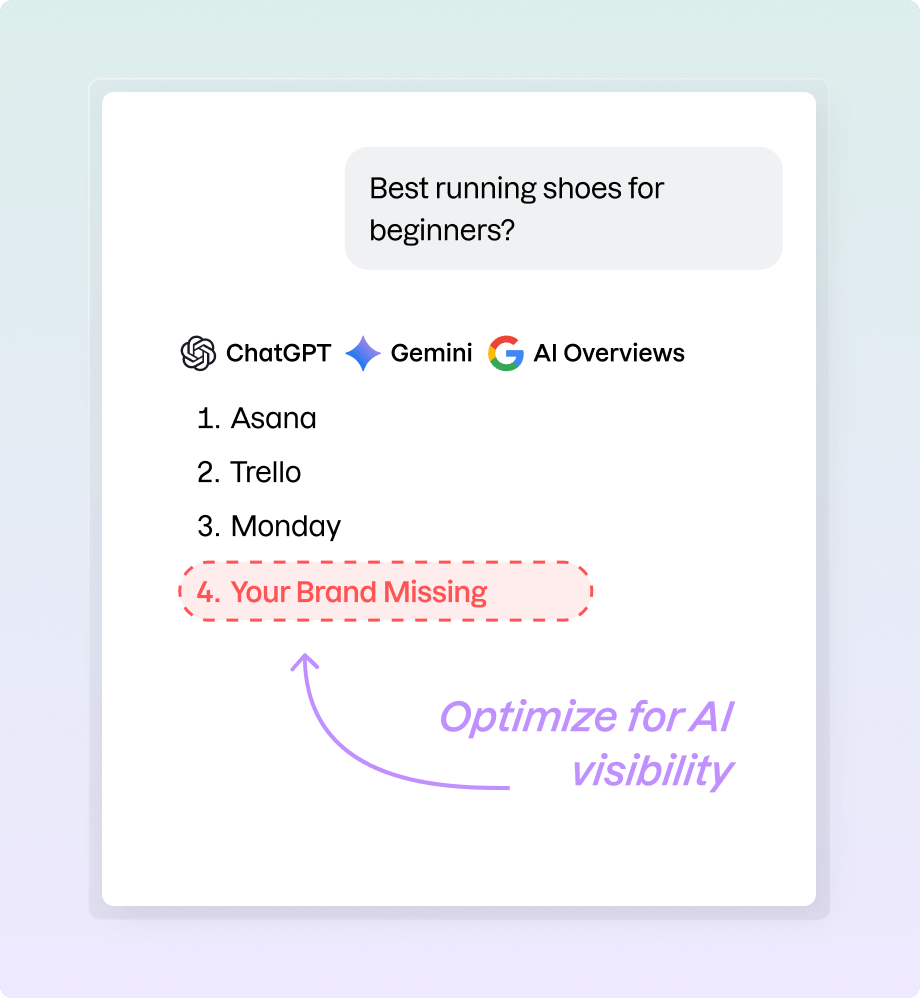
Low AI visibility can mean AI platforms don’t mention your brand, mention competitors instead, or describe your brand in a limited or inaccurate way.
AI visibility analysis can include brand mentions, citations, sentiment, competitive comparisons, and the specific prompts or questions that trigger your brand to appear. These signals help you understand how AI platforms represent your brand and how often they include it in relevant search experiences.
Why AI Visibility Matters for Your Brand
AI visibility matters for your brand because it determines whether your brand is part of the conversation when people use AI platforms to research, compare, and choose businesses like yours.
When AI platforms mention your brand in relevant answers, users can discover you earlier in their decision process. These users are also typically closer to taking action because they’ve already asked a specific question, compared options, or looked for a recommended solution.
AI visibility also shapes trust. When an AI platform includes your brand in an answer, it can make your brand feel more relevant to the user’s need.
When your brand doesn’t appear in AI answers, users will only see competitors or get an incomplete view of the market.
Tracking AI visibility helps you see where your brand appears, where competitors appear instead, and whether AI answers describe your brand in a way that is accurate, relevant, and useful for potential customers.
Which AI Search Platforms Do We Check?
ChatGPT
ChatGPT is OpenAI’s conversational AI assistant and the most widely used AI chatbot in the world. ChatGPT is where most people now go to research products, compare brands, and get recommendations, often before visiting a search engine like Google.
Gemini
Gemini is Google’s consumer AI assistant, built directly into Search, YouTube, Workspace, and Android devices. Gemini’s integration across the Google ecosystem gives it massive reach with both everyday consumers and business users.Google AI Overviews
AI Overviews are the AI-generated summaries that appear at the top of many Google search results pages. AI Overviews pull from multiple websites into one short answer and link only to the sources Google cites, directly shaping which sites still get organic traffic.Google AI Mode
AI Mode is Google’s full conversational search experience that replaces the standard list of blue links with a generated response. AI Mode supports follow-up questions in a single session, so brands cited early can stay in front of users throughout their entire research journey.
Are you ready for the AI search era?
Ensure your website is positioned for success with the AI Visibility Toolkit:
Track visibility across ChatGPT, Gemini, AI Mode, AI Overviews, and more
See the exact prompts where your brand appears and where competitors win instead
Analyze sentiment, citations, and source pages behind every mention
Benchmark your AI Visibility Score against any competitor you choose
What’s in Your AI Visibility Report?
Your free AI visibility report includes the following data points:
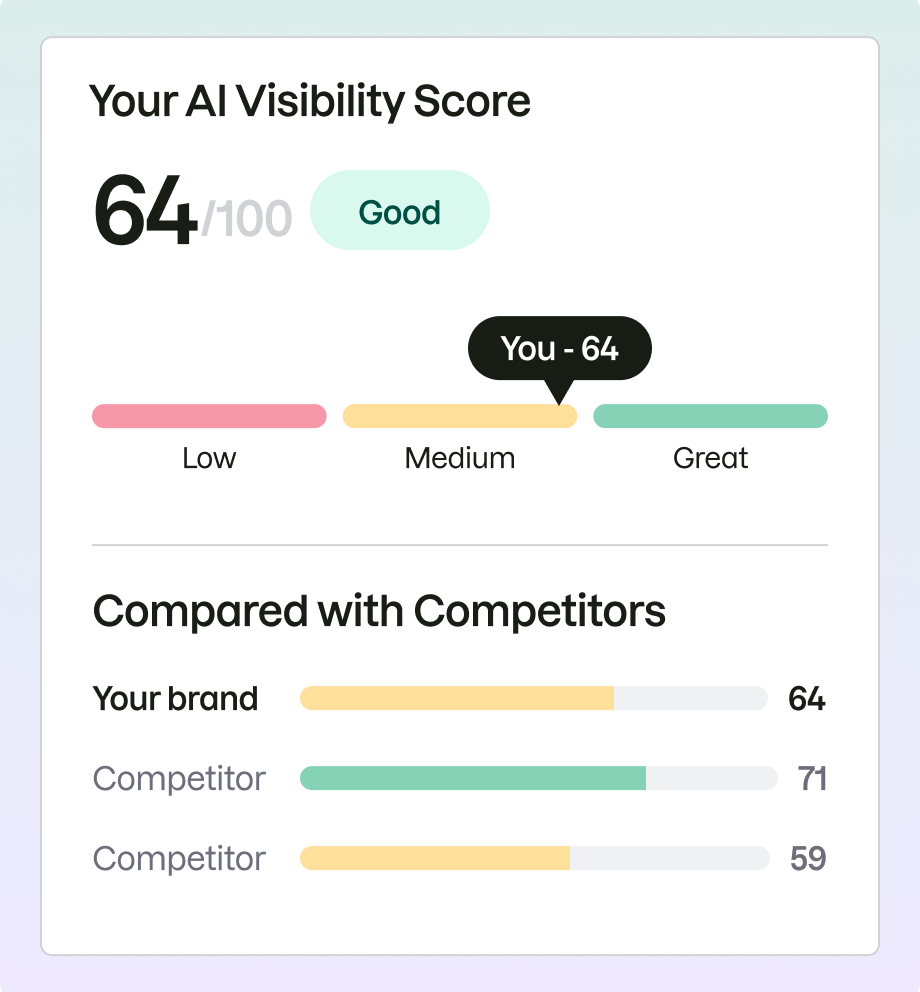
- AI Visibility Score: A 0 to 100 metric that represents how often your brand appears in AI-generated answers compared to others in your industry. Use it as a baseline to track progress month over month.
- Mentions: The total number of times your brand name appears in AI-generated answers across the platforms we check. The higher the count, the more AI tools recognize you as a relevant answer.
- Citations: The total number of times AI platforms link to your website alongside their answers as a source. Earning citations is how you turn AI search visibility into real referral traffic to your site.
- Platform Coverage: A per-platform breakdown showing which AI tools mention you and how often. This tells you where you’re already visible and which platforms still need work.
- Audience Reach: An estimate of how many people see your brand mentioned across AI platforms each month. Use it to evaluate the real-world scale of your AI visibility.
- Top Cited Pages: The specific pages on your website that AI platforms cite most often when answering questions related to your brand or industry. Study these to understand what kind of content AI tools trust enough to cite.
- Best Performing Topics: The topics and themes where your brand shows up most often in AI answers. These are your existing strengths to defend and build on.
- Topic Volume: The estimated search demand behind each topic AI tools surface for your brand. Pair it with mentions to see which topics drive the most real opportunity.
- Competitor Comparison: A side-by-side view of your AI Visibility Score, total mentions, and estimated reach across all AI platforms compared to your closest competitors. See exactly where you stand in AI search overall and how far you have to climb.
How to Interpret Your AI Visibility Score
Your AI visibility score provides a high-level view of how visible your brand is compared to other brands when people use AI platforms to find answers related to your business.
The score is based on how often your brand appears in relevant AI answers, how it compares with other brands, and whether it shows up for the prompts that matter to your audience.
A higher score means your brand is more visible in AI search results. A lower score means competitors may be appearing more often, or your brand may be missing from important answers.
Use your score as a baseline. Then review the prompts, mentions, and competitor comparisons behind it to understand where your brand is visible, where it’s missing, and where AI platforms may need clearer or more accurate information about your business.
How to Improve AI Search Visibility
Close visibility gaps with competitors
Identify prompts where competitors appear but your brand does not. Create or update content that addresses those same questions and use cases, so AI assistants have the context they need to include you.Earn brand mentions from authoritative sources
AI platforms use trusted third-party sources to understand which brands are relevant, credible, and commonly associated with a topic. Earn mentions in industry publications, review sites, comparison pages, partner content, and expert roundups where your audience already researches solutions. These mentions help AI platforms connect your brand with the right categories, use cases, and customer questions.Back up your claims with proof
On your own site, don’t just describe who you serve and what you do. Show it. Add case studies, named customer stories, original research, and specific numbers to the pages that describe your product, audience, and use cases so AI tools have evidence to cite, not just marketing copy.Create useful content with original value
Create high-quality content that addresses real user problems and brings a distinct point of view, as AI platforms will just synthesize generic, recycled content into their own summary answers. Share your team’s hands-on experience, specific frameworks, customer stories, and original perspective on the questions your audience cares about.Ensure brand positioning is clear and consistent
Use the same brand name, descriptions, audience, and language on your website, LinkedIn, G2, Capterra, partner directories, and any website that describes you. When every source repeats the same wording and positioning, AI platforms can confidently match your brand to the prompts you want to show up for.Focus on high-impact prompts
Use prompt and topic data paired with search volumes to prioritize the topics with the greatest demand. Tailor your content so it answers these questions directly and signals relevance to both search engines and AI models.
How to Monitor AI Brand Mentions
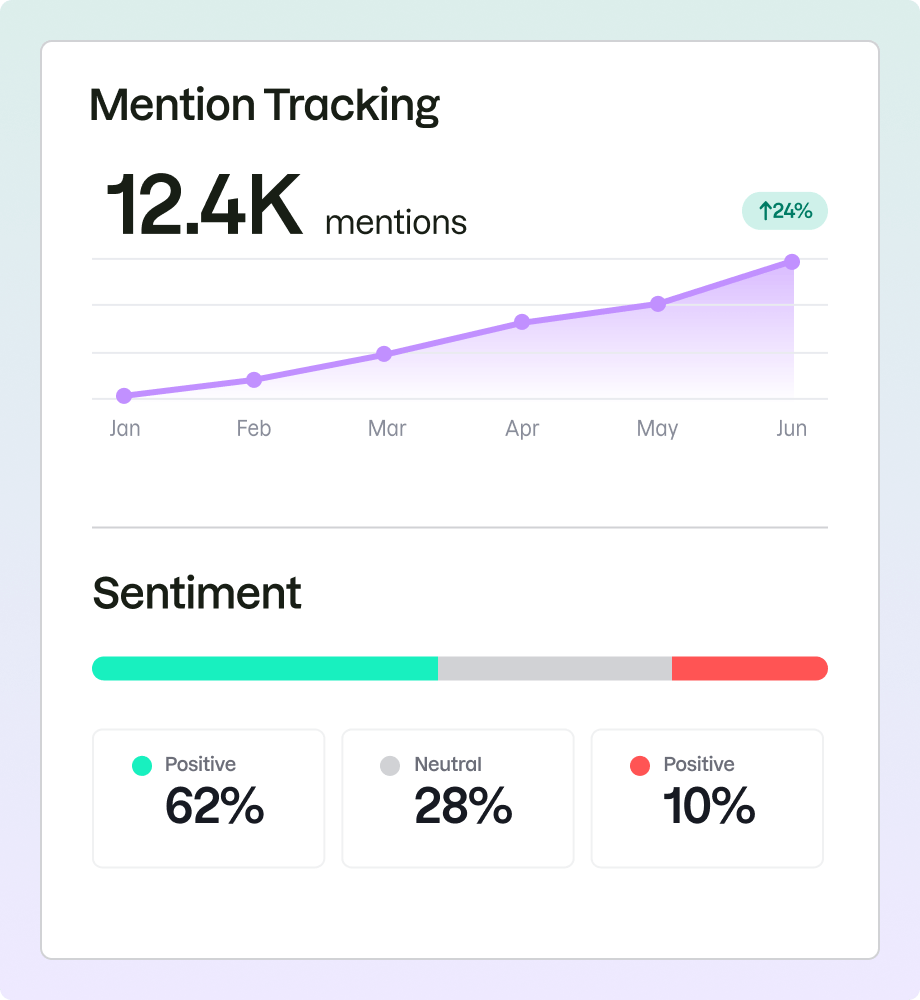
Monitor AI brand mentions by tracking where your brand appears, how prominently it appears, how it is described, and how those results change across AI platforms over time. Try using a tool like the AI Visibility Toolkit.
Start with prompts related to your brand, products, services, category, and competitors. For each prompt, check whether your brand is mentioned, which competitors appear, and whether your brand appears before or after them.
Then review how AI platforms position your brand. Look at whether the answer describes your brand accurately, connects it to the right use cases, and includes the strengths or differentiators that matter to your customers.
You should also track sentiment. Note whether mentions are positive, neutral, negative, or mixed. Negative or unclear mentions may point to outdated information, weak positioning, or third-party sources that do not reflect your current offering.
Compare results across platforms. Your brand may appear often in ChatGPT but less often in Gemini, AI Mode, or AI Overviews. These differences can help you identify where your brand is visible, where competitors are stronger, and which topics need more support.
Turn AI visibility data into growth
Use Semrush One to connect AI visibility insights with SEO tools that help you grow your reach, rankings, and traffic.
Track AI visibility across major platforms
See where competitors are mentioned instead
Find SEO opportunities tied to real search demand
Improve content for both AI search and Google
AI Search Optimization vs. SEO
AI search optimization and SEO both help brands become easier to find online, but SEO focuses on ranking pages in search results, while AI search optimization focuses on getting a brand mentioned in AI-generated answers.
Here’s how SEO and AI search optimization compare across five key dimensions:
What you measure
AI search optimization measures how often a brand appears in AI-generated answers, how prominently it appears, and how it is described. SEO measures page rankings, impressions, clicks, traffic, and conversions from search results.How content is selected
AI platforms use trusted third-party sources to understand which brands are relevant, credible, and commonly associated with a topic. Earn mentions in industry publications, review sites, comparison pages, partner content, and expert roundups where your audience already researches solutions. These mentions help AI platforms connect your brand with the right categories, use cases, and customer questions.How you optimize
AI search optimization focuses on making a brand easy to understand, trust, and mention in relevant answers. SEO focuses on improving pages through search intent alignment, technical performance, internal links, and backlinks.What role your website plays
In AI search optimization, your website is one important source, but AI platforms may also use third-party articles, reviews, forums, and comparison pages to understand your brand. In SEO, your website is usually the main asset being optimized so specific pages can rank and earn clicks.How you track performance
AI search optimization is tracked by running relevant prompts across AI platforms and measuring mentions, sentiment, answer accuracy, share of voice, and competitor presence. SEO is tracked through tools that measure keyword positions, impressions, clicks, click-through rate, organic traffic, backlinks, and conversions.
Why Use Semrush’s AI Visibility Tool?
You should use Semrush’s AI Visibility Tool because it’s powered by Semrush’s AI Visibility Toolkit, which uses large-scale AI search data to show how your brand appears in AI-generated answers.
The tool draws from a database of 26M+ prompts and responses across ChatGPT, Gemini, AI Mode, and AI Overviews. This helps you see where your brand is mentioned, how it compares with competitors, and whether your visibility reflects a real pattern instead of a one-off result.
Semrush also updates key AI visibility data daily and supports analysis across 220+ countries and regions. That means you’re using data built to help you understand real-world patterns in AI search visibility.
And because the tool is connected to the rest of Semrush, you can move from insight to action in the same platform. When you find a visibility gap, you can use Semrush’s SEO and content tools to research keywords, improve content, track rankings, and strengthen your broader search presence.
Frequently Asked Questions
Is the AI Search Visibility Checker Free?
Yes, the AI Visibility Checker is free to use. You can use the tool three times per day for free, without registering or creating an account.
For deeper AI visibility analysis, prompt tracking, competitor insights, and ongoing monitoring, try Semrush’s full AI Visibility Toolkit.
Which AI Search Platforms Does the Tool Check?
How Often Is the Visibility Data Updated?
Why Do I See Different AI Answers When I Test Prompts Myself?
Who Should Use the AI Visibility Checker?
